1348 Words. Average 5 Minute Read Time.
I can’t name a person who woke up one morning and announced, “Hey! Today I am becoming a caregiver.”
That’s not how it works.
Life happens first.
The roles come later.
“I didn’t begin caregiving with a title, a plan, or a calling neatly written out before me. I began it as a daughter. A sister.”
Long before I understood the language of caregiving, I was already living it.
My sister was born with special needs, and my mother stepped into a role she never clocked out of.
She was Advocate. Protector. Coordinator. Planner. Constant presence.
She didn’t introduce herself as a caregiver.
She was simply Mom.
And I became her little helper.
My sister’s babysitter.
Normal stuff, right?
In the beginning
Often, caregiving begins with watching someone you love carry something heavy and wanting to help.
Other times, you are called to help.
For years, my role was partly observer and apprentice.
I watched my mother.
I learned how to help without overtaking.
How to support without resentment. (Unfortunately, and honestly, those emotions came later.)
Some caregivers learn how to prepare without prematurely grieving.
I never questioned what would happen when I had to step into Mom’s place. Always a realist, I had already taken on the caregiver role at an early age without knowing the name.
Instinctively and at a young age, I knew that life isn’t static.
People age.
Health changes.
Parents grow tired and sometimes ill.
I’d mature, have a family, and the responsibilities would shift.
I probably ran many men away with the confession that my sister and I are a package deal.
Prematurely, this notion affected not only my relationships, but employment, where I live, and what I began to imagine for my future. Even how I identified myself.
Maybe you can relate on some level?
The isolation nobody talks about
One thing I didn’t fully understand until recently was that my mindset around caregiving created its own kind of isolation.
When caregiving is long-term or lifelong, and someone in your family is born with something that has no known cure, caring can become invisible to people outside it.
Close family and friends may sympathize, but they cannot always understand the layers. My childhood friend did, likely because she lived with us for a short while. She loved my sister as much as I did and was as protective and connected as a birth sister. But because she was not blood, she eventually moved on.
Friends come and go. Because I miss being social, I started sharing on social media. My sister’s pictures get the most comments from old classmates and friends who tell me how much they enjoy my stories about her. My personal stories don’t grab their attention as much. Acquaintances may offer kind words and then move on to lighter conversations.
And even inside families, caregiving exempts you from certain activities. (When Mom says everything needs to be wheelchair accessible if you want us to come. She means everything.)
I’ve personally felt guilty for going places and doing things my mom and sister couldn’t. The unequal distribution of caregiving within a family can create misunderstandings, resentment, silence, and unhealthy self-talk.
When this happens repeatedly, we learn to shield ourselves from the pain by pulling away. We avoid calls and make excuses not to participate. Some excuses are valid, like needing wheelchair accessibility. lol!
Isolation becomes our new normal.
Not dramatic.
Not sudden.
Just familiar.
We get comfortable with our routines and around our things. So comfortable that we make caregiving look easy. We do it so well that no one attempts to pull us out of the isolation.
This is where I saw my mother.
This is where I saw myself.
People are not roles.
We are not roles. We are people with responsibilities that include caring for someone else.
We are called and equipped at times, but mostly we are figuring out the complexities as they come.
Underneath the umbrella of “caregiver,” we are still people.
After the appointments, we are still humans.
Before the medication is administered, we are a person.
During the advocacy work, transporting, planning, crying, problem-solving, and contemplating the “what ifs,” we are people with interests and dreams.
We are a spirit, with a soul, living inside a body.
Our spirit doesn’t disappear simply because caregiving becomes a significant part of our life.
But we are often the ones who lose sight of that reality first.
And trust me, no one is coming to save us from ourselves.
We must remember
Who we were before the roles and responsibilities carried us into isolation.
Because we are still there.
My search for community
By 2018, I had fully concluded, as I observed this new isolated life, that something had to change.
If my family—and families like mine—were going to thrive again, we had to move through caregiving with a renewed sense of joy, connection, and resilience.
We had to combat isolation with community.
We needed to connect with people who could walk alongside us because they understood the path firsthand. We needed a caregiver community.
We did not need institutional care. However, it’s there for people if they do.
We did not need a formal therapy space. However, there is nothing wrong with getting counseling. It’s a great place to start before entering a caregiving community.
However, what we needed was a place where caregivers could:
Laugh.
At our own jokes.
Learn.
Because navigating all the care options and federal and state agency programs is overwhelming!
Pray.
Who doesn’t appreciate agreement with like-minded individuals?
Rest.
Reminding ourselves that rest is a part of remaining healthy for ourselves and our loved ones.
And be present without having to explain ourselves.
Aaaah!!! That felt good.
The laughing, learning, praying, resting, and being present with others reminded me who I was again, what I enjoyed, and the purpose of life.
Iron sharpens iron
ReallyLeah socials (the blog and videos) explore
Not just:
How do we become better caregivers when the season arises? (Because it will)
But also:
How do we remain human while we offer care?
How do we stay connected to our community?
How do we maintain or rebuild parts of life that caregiving changed?
How do we remember that our story matters right now?
Caregiving may be part of your story, too, but it is not the whole of who you are.
A reflection for you
I want to leave you with a question:
Who are you underneath the caregiving role?
Not your loved one’s diagnosis.
Not your responsibilities.
Not your busy schedule.
Not your title.
You.
What do you enjoy?
What have you stopped doing?
Who or what makes you laugh?
Who can you really talk to about you, and they will stay long enough to hear the answer?
Finding your way back to yourself begins with remembering that underneath surviving, there is a beautiful self to return to. And you can’t really give your loved one your best when you are not your beautiful self.
Really,
Leah
🎧 Listen to Chapter 2
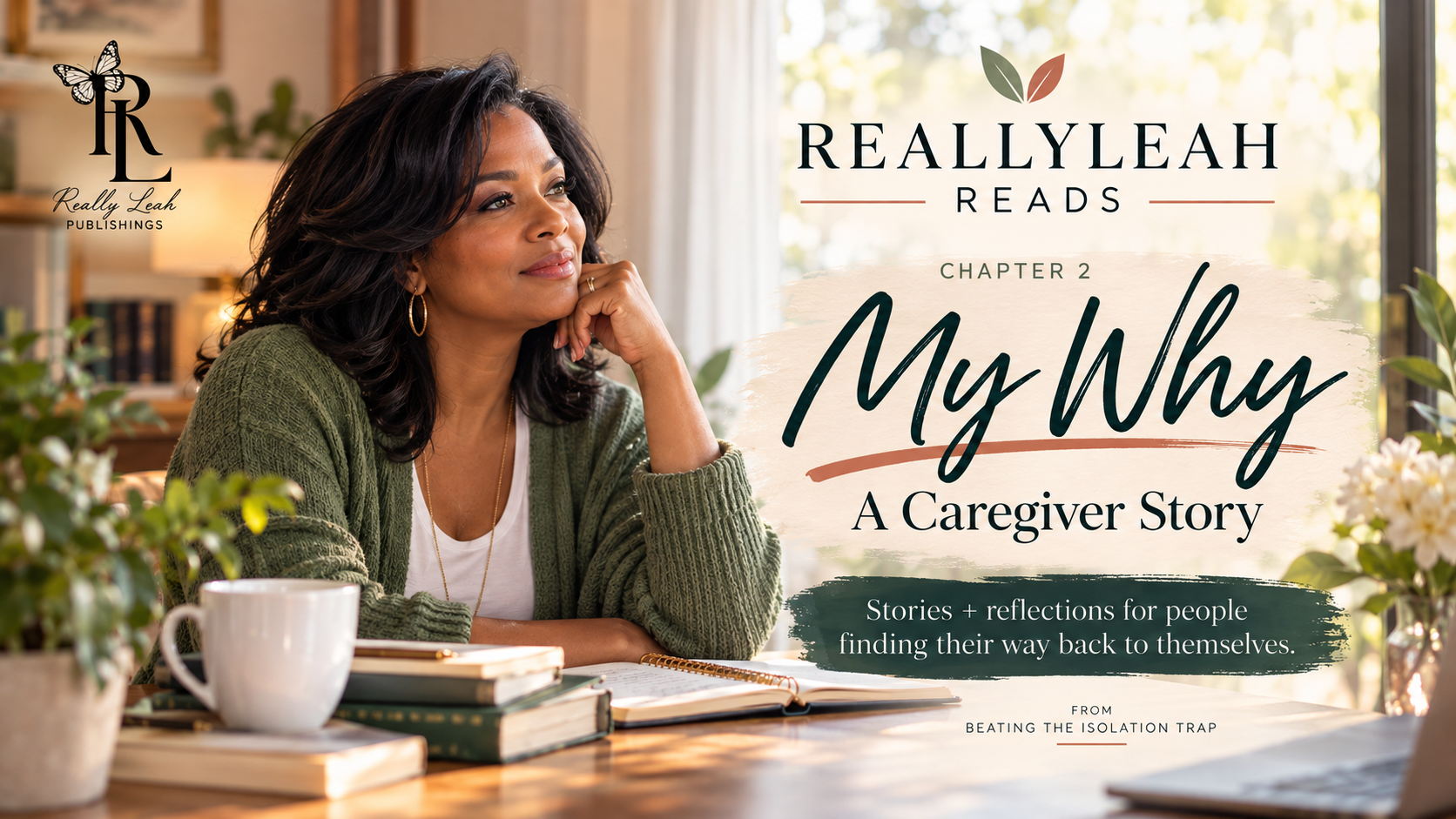
This story continues in ReallyLeah READS, where I read Chapter 2, My Why: A Caregiver Story, from Beating the Isolation Trap: An Authentic Caregiver’s Guide to Reconnecting, Recharging, and Thriving.
[WATCH / LISTEN TO CHAPTER 2] https://youtu.be/plxwk3fdBws
Stories + reflections for people finding their way back to themselves.
📖 Continue the journey
If this reflection resonates with you, I invite you to continue the journey through the book and on the blogs. You’ll gain more insight into first steps, self-awareness, resources, and how to address those pesky family dynamics. You can note your personal reflections in the printed copy.
Beating the Isolation Trap explores what happens when caregiving changes our relationships, our routines, our sense of self—and what it can look like to begin reconnecting, recharging, and thriving.
Leave a Reply