I wish someone had given me a little book when I first became a caregiver.
I didn’t want a manual full of medical terms. I wouldn’t have had time to read or understand it. I also didn’t need a checklist of tasks. I already felt overwhelmed by all I had to manage for my loved one.
What I really needed was someone beside me saying, “This experience will change you. You’ll learn things you never expected. You’ll become a good listener, a problem-solver, and sometimes, you’ll be the one who is simply present for your loved one.”
Because you belong there.
I didn’t understand that then.
I Didn’t Know What I Didn’t Know
My precious sister was born with cerebral palsy and hydrocephalus. Like many families of our generation, both of our parents worked. My mom worked in retail, often on a schedule that didn’t coincide with mine, and my dad traveled for work.
I was a latchkey kid when I first started babysitting. My best friend and I would watch my sister with plenty of help from her older cousin, who babysat all of us. But I always felt personally responsible for my sister, no matter who was around.
Although she was a sweet, easygoing child, there were times when she would hit her head on the floor or strike her head with her fist. We didn’t know much then about noises, triggers, or what might cause those behaviors. It was frightening. We simply did our best to keep her safe.
For many years, all was well. My sister participated in Special Olympics, sang in church, and fascinated us with her remarkable memory.
Then a seizure changed our lives.
One of her legs noticeably atrophied, making it difficult for her to balance, then walk, and eventually stand. She became increasingly dependent on others. Her care needs grew more complex, and our family had to adjust again.
My mother had always been her primary caregiver. I wasn’t.
And I wasn’t a nurse.
But I was involved.
I helped mentally, logistically, relationally, and sometimes physically. I helped my mother think through doctors’ treatment plans, medical waiver plans, insurance, and whatever else she needed to navigate.
Nobody Hands You a Roadmap
Caregivers learn the appointments, your loved one’s routines, and what makes them comfortable. We know what a particular look means. And we learn quickly the difference between something being wrong and something being a crisis.
What Families Know That Isn’t Always in the Chart
We Know What “Normal” Looks Like
One of the most important lessons my family has taught me is this:
The family caregiver sitting beside the patient often knows something the chart doesn’t.
When my sister had a violent seizure in her twenties, the ER doctor subsequently put her on a new medication. Almost immediately, her behavior changed.
At first, we thought the behavior was related to the seizure. But it was unlike anything our family had seen from her before. Everyone around her—including people at her work-study program—noticed the difference.
My mother became afraid to take her places because she never knew when my sister might erupt into a situation that seemed impossible to calm.
Those were hair-pulling times, requiring a lot of prayer on my mother’s part.
Eventually, my mother felt strongly that the new medication was contributing to the problem. She worked with my sister’s neurologist, who evaluated the situation and agreed with her course of action.
The erratic behavior disappeared.
My sister never experienced those behavioral problems again, nor has she had another seizure.
My mother didn’t have a medical credential.
But she knew her daughter.
It means the two kinds of knowledge can work together.
A nurse may know the diagnosis, treatment plan, medications, vital signs, and clinical history.
That knowledge matters.
For families like mine, the person we love isn’t a diagnosis.
The Patient Is More Than a Diagnosis
She’s my sister.
She is a whole person with preferences, personality, history, relationships, and a way of communicating that her family has spent a lifetime learning.
When “Do It at Home” Isn’t That Simple
Willing Isn’t the Same as Equipped
Physical therapy has taught our family another lesson.
We have watched my sister lose ground in her mobility when therapy was interrupted by the authorization process. We told her doctors that she did not respond to cues from us the way she responded to professional therapists.
Yet the answer was often some version of, “You can do these exercises with her at home.”
And they would hand us pages of exercises.
Our response was, “She doesn’t respond to us as an authority when we get home.”
But there is a difference between being willing to help and being equipped to provide the same care a trained professional can provide. We don’t have the specialized equipment, foam pads, treatment beds, or bars available in a therapy setting. We also have the rest of life happening around us.
The best experiences we’ve had were with physical therapists who came into our home and worked with my sister and her caregiver. They showed us how to use what we already had and suggested things we could purchase.
Those visits felt different.
I couldn’t help thinking: What if this were their loved one? With their knowledge, what would they do?
Would they give up so quickly?
Or would they look for another way?
The Family Caregiver Is Part of the Care Team
I didn’t have the language for this when I first became involved in my sister’s care.
I do now.
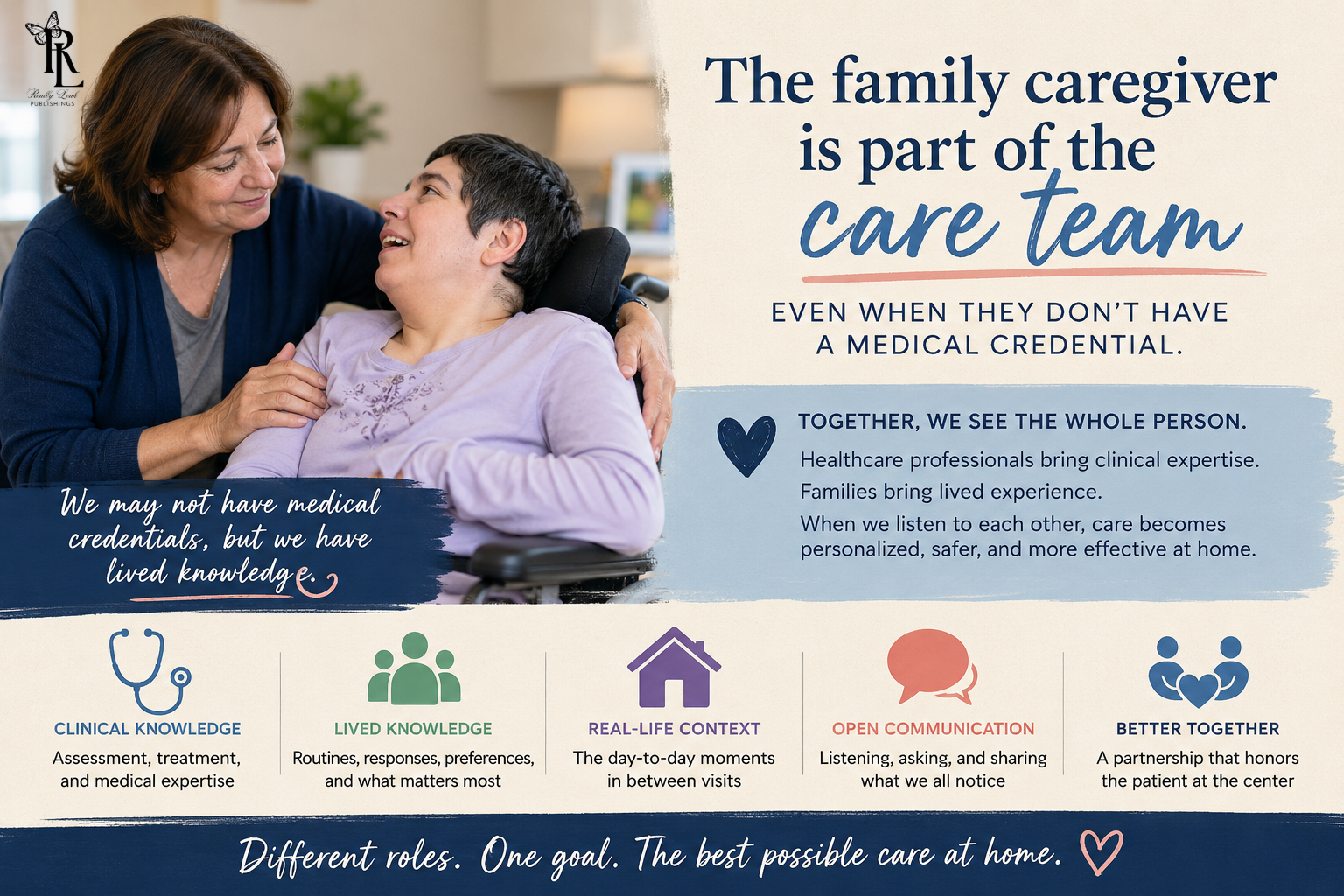
The family caregiver is part of the care team—even without a medical credential.
That doesn’t mean caregivers should perform clinical duties they aren’t trained to perform.
It doesn’t erase professional boundaries.
And it certainly doesn’t mean the responsibility for safe, appropriate care should shift to families.
It means working together as partners.
For someone receiving care at home, the family is there long after the nurse or therapist leaves.
Families see the morning challenges.
The subtle changes.
We carry the emotional weight of what happens next.
So ask us:
Ask What They Have Noticed
“What have you noticed?”
That simple question can open a door and allow us to speak up in a foreign environment.
What I Hope Professionals Understand
If I could go back and talk to the child I was when I first became a caregiver, I would tell her she wasn’t supposed to know everything.
I would tell her to ask questions.
I would tell her it was okay to say, “I don’t understand.”
And I would tell her that asking for help wasn’t a sign she wasn’t doing enough.
I would also want healthcare professionals to understand that families are learning, too.
We are trying to understand a system with its own language, expectations, schedules, and pressures.
We may seem overly protective because we love our person to the moon and back.
And sometimes we may not communicate well because we’re tired and need a break.
None of that means we don’t want to partner with you.
We want the same thing you do.
We want the person we love to be safe.
We want them treated with dignity.
We want them to receive good care.
And when we aren’t sure what to do next, we want to know someone will help us find our way.
There Is Hope in Working Together
My caregiving journey has taught me that good care is not simply about what one person can do for another.
Communication.
Trust.
And recognizing the people carrying pieces of care that may never appear in a medical record.
My sister taught me that.
My mother taught me that.
And caregiving taught me that sometimes the most important thing a professional can do isn’t simply to tell a family what to do.
It’s listening.
Listen to what the family has noticed.
Listen to what they’re worried about.
Listen to what they know about the person you’re caring for.
Then bring your professional knowledge alongside theirs.
Because neither side has to do this alone.
The doctor and nurse bring clinical knowledge. A social worker brings resources. The therapist brings specialized expertise. The family caregivers bring lived knowledge. And the patient comes with their own voice, preferences, history, and humanity.
When everyone’s perspective comes together, care becomes more than a task to complete or a chart to review.
It becomes a partnership.
Maybe that’s what I really needed when I started as a caregiver—not a perfect guide, but the reassurance that I belonged on the team.
I hope other families get that understanding much earlier than I did. Because sometimes knowing you fit in the solution is the first step in finding your way.
No one knows it all, and that’s exactly why we need each other.
Really,
Leah
Do you know someone who is suddenly caring for a loved one?
Read more. We’re building a movement that expands support, resources, respite and financial opportunities throughout Florida and the nation. You’re invited to join our family caregiver community.
Leave a Reply