
Dear Creative,
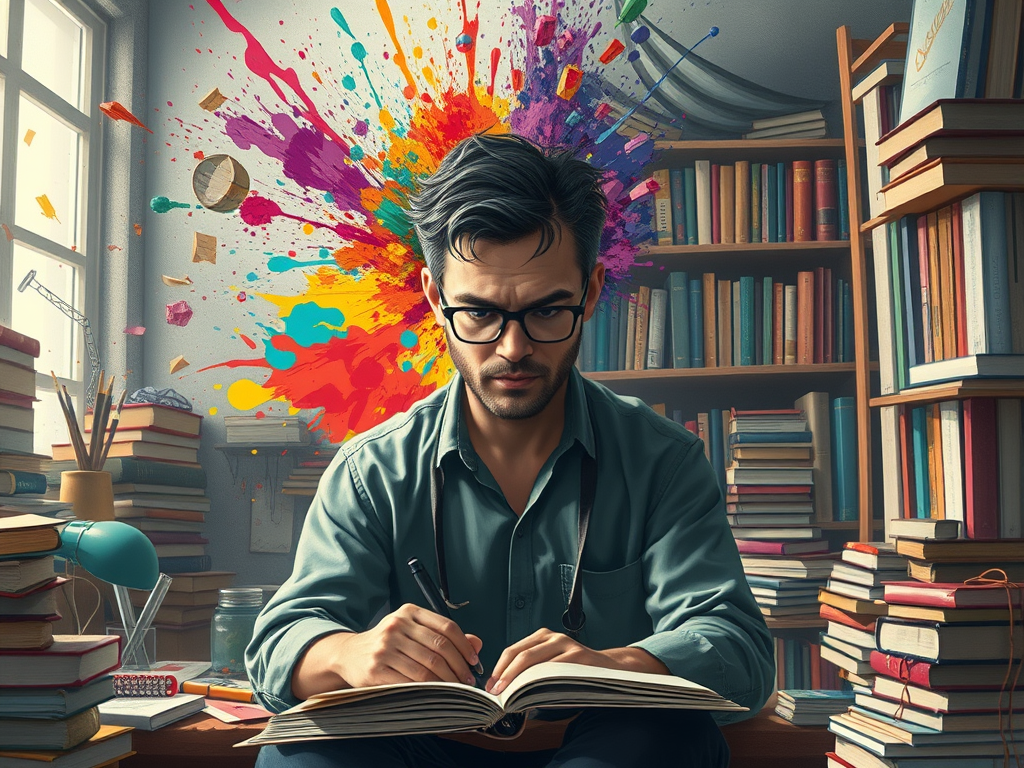
I hope you are swimming in the sweet spot of right-brain creativity and left-brain refinement today. If not, I hope this letter helps you find the right balance, as successful artists often do in their creative process. While neuroscience has moved away from oversimplifying the right-brain and left-brain dichotomies, there is still too much anecdotal and practical support to deny it works! So, let’s lean into those bursts of freeform followed by those hours of structured repolishing, and leave the scientists to their study of neurology.
Here’s why:
“You don’t write songs, you find them, and then you fix them”
Paul McCartney
In music, the greats like the Beatles’ Paul McCartney have spoken about how songs, like “Yesterday” hit him in a dream (a right-brain spark) and other songs came as a result of spontaneous jam sessions. Then the left-brain did the logical work of arranging and tweaking melodies, adding lyrics to support the spark, and coming up with the final composition. Musicians and composers often improvise a melody then arrange it with chords, rhythm, and harmony, giving it left-brain order. McCartney most often did this with a little help from his friend, John Lennon. McCartney’s quipped, “You don’t write songs, you find them, and then you fix them,” highlighting that masterful interplay.
“The first draft is the child’s draft, where you let it all pour out and then let it romp all over the place, knowing that no one is going to see it and that you can shape it later.”
Anne Lamott
In writing, we studied the successful Anne Lamott and her book Bird by Bird which pushes the “sh—-y first draft” concept. Lamott instructs students to initially write without filtering their thoughts, then to revise thoroughly with careful consideration and logic. She’s said, “The first draft is the child’s draft, where you let it all pour out…” Then she advises us to clean it up. Again, the dual process of creating and refining as a practical and inspirational mode of making sure nothing is wasted as writers waddle, along with their characters, to a final resting place.
“Learn the rules like a pro, so you can break them like an artist”
Pablo Picasso
In visual arts, the prolific Pablo Picasso’s evolution of works like “Guernica” shows a similar pattern. Early sketches are chaotic, expressive, almost abstract—pure right-brain experimentation. But the final piece is meticulously composed, with deliberate lines and symbolism, hinting at left-brain refinement. Other types of design work this way too. In architecture or User Interface for technology, creatives start with bold, out-the-world concepts first, then refine them with measurements, usability, or code.
Picasso himself said, “Learn the rules like a pro, so you can break them like an artist,” suggesting a blend of disciplined structure and creative freedom. We see that playing out in the tech-world every day.
“I start with a feeling and then figure out how to make it work as a story”
Sophia Coppola
Even in film, directors take their often-intuitive ideas (right-brain intuition) to a larger group of principals like screenwriters and cinematographers who help shape through editing and storyboarding (left-brain rigor), their vision into the cohesive narratives we see on screen. Surrealist David Lynch, who has given us so much in film has said, “Ideas are like fish. You don’t make the fish, you catch them,’’ and Sophia Coppola is quoted as saying, “I start with a feeling and then figure out how to make it work as a story,” and Christoper Nolan, admits that filmmaking is “a balance between intuition and logic.
If you are not inspired to get “it” out of your head, to throw some paint on a canvas, to write some words on a page, to pen some lyrics in a notebook, then I don’t know what to say to you, today. Perhaps this is the difference between those who jump in with both feet to do the impossible and those who deny their original ideas and purpose and only become a carbon copy of someone more talented. But if you’re waiting for perfection, you will wait forever.

Perfection is for those who will never complete much. Errors and moderate achievements are intrinsic to life. It’s up to us to leverage all those sad starts and messy middles. Mastery is attained by learning from our mistakes.
My hope for you and I is that we will allow The Creator to give us the sparks we need, again and again, and then to follow The Spirit’s guidance to the end. Here is where the sweetest flow and harmony for our creativity exists. Really,
Leah
Leave a Reply